






Accepted Papers
The section containing accepted papers prior to their appearance in the forthcoming issues of Materials Science-Poland, is available on: Ahead of Print Articles.
Current Issue
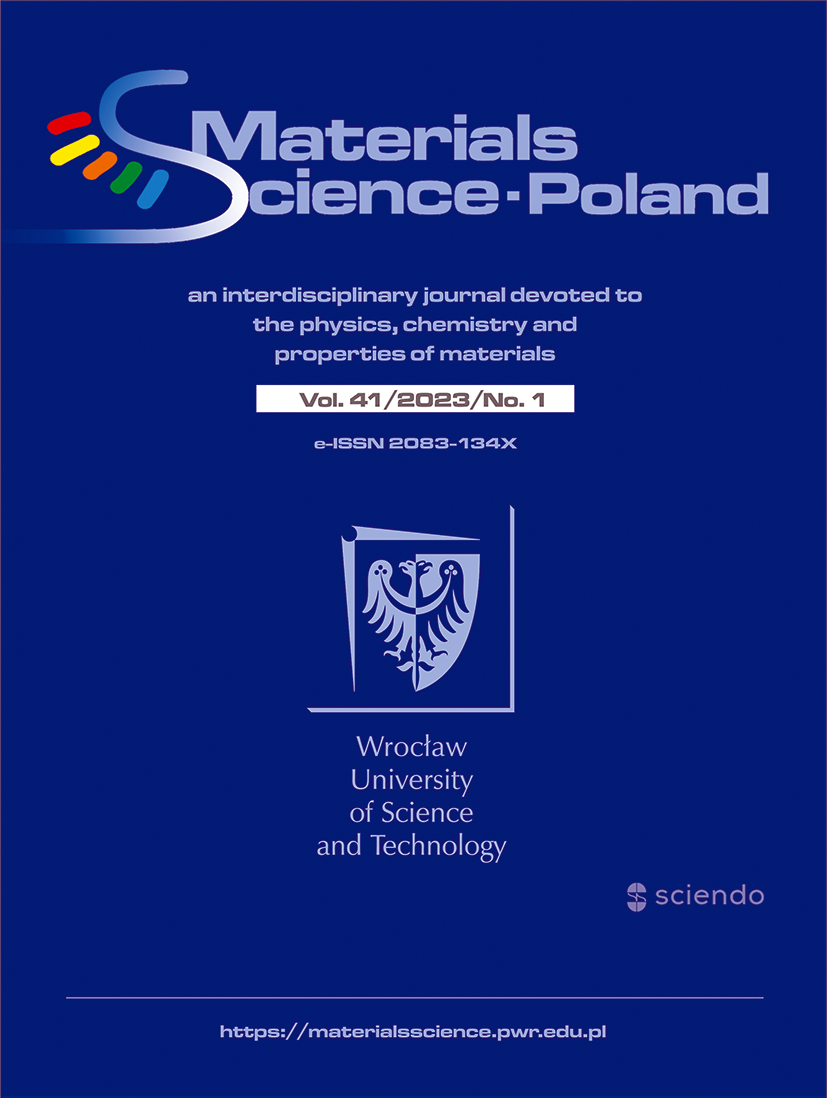
The current issue (Vol. 44, No. 1, 2026) of the journal of Materials Science-Poland is now available on Sciendo.
For more details please, refer to the Sciendo website.
Back Issues
Effects of Polarization of Radiofrequency Radiation in Polycrystalline ESR
V. E. Fainzilberg
Department of Chemistry, Long Island University, USA

Redispersable Nanopowders for Wet Chemical Coatings Processes: Application to Transparent Conducting Coatings
N. Al-Dahoudi, M.A. Aegerter
Institut fuer Neue Materialien gem. GmbH - INM
Department of Coating Technology, Saarbruecken, Germany
Luminescent Materials, Recognition Phases of The Chemical Sensors and Heterogeneous Catalysts Prepared By Sol-Gel Method
Andrzej M. Kłonkowski
Faculty of Chemistry, University of Gdańsk, Poland
Spectroscopic Studies on the Inclusion Complexes of Tetrakis(2-hidroxy-5-nitrophenyl)porphyrin with α-Cyclodextrin in Solution and in Sol-Gel Matrix
A. O. Ribeiro, C. R. Neri, Y. Iamamoto and O. A. Serra
Rare Earth/Bioinorganic Laboratory - Chemistry Department - FFCLRP
University of São Paulo, Brasil
Comparison of Sol-Gel and Solid State Prepared Eu2+ Doped Calcium Aluminates
Tuomas Aitasalo1,2, Jorma Hölsä1,3, Högne Jungner 4, Mika Lastusaari1,2, Janne Niittykoski1,2
1University of Turku, Department of Chemistry, Finland
2Graduate School of Materials Research, Turku, Finland
3ENSCP, CNRS, Laboratoire de Chimie Appliquée de l'Etat Solide, Paris, France
4University of Helsinki, Dating Laboratory, Finland
Highly Porous Aerogels with Very Low Permability
J. Phalippou, T. Woignier, R. Sempéré, Ph. Dieudonné
Laboratoire des Verres - UMR CNRS 5587, Université de Montpellier, France
The Study of Thermal Disordering of The KSc(WO4)2 Crystal Structure by Raman Spectroscopy
M. Mączka, J. Hanuza, N. Sidorov and S. Kojima
Institute of Low Temperature and Structure Research, Polish Academy of Sciences, Wrocław, Poland
The Electrochemical Redox Reactions in Solvated Silica Sol-Gel Glass
Marcin Opallo
Institute of Physical Chemistry, Polish Academy of Sciences, Warszawa, Poland
Structure, Spectroscopy and Dielectric Properties of BaTiO3:Eu3+ Nanocrystallites Prepared by The Sol-Gel Method
D. Hreniaka, E. Łukowiaka, K. Maruszewskia,b, R. Pązikc, and W. Stręka
aInstitute for Low Temperature and Structure Research, Polish Academy of Sciences, Wrocław, Poland
bMechanical Faculty, Institute of Materials Science and Applied Mechanics,Wrocław University of Technology, Poland
cChemistry Department, Opole University, Poland
Optical Behavior of Sol-Gel Derived Photonic Structures Formed by Submicron Silica Spheres
M. Jasiorski1, K. Maruszewski1,2 and W. Stręk1
1Institute for Low Temperature and Structure Research, Polish Academy of Sciences, Wrocław, Poland
2Mechanical Faculty, Institute of Materials Science and Applied Mechanics,Wrocław University of Technology, Poland
Lu2O3:Eu, a New X-ray Phosphor
E. Zych*, D. Hreniak and W. Strek
*Faculty of Chemistry, University of Wrocław, Poland
Institute for Low Temperature and Structure Research Polish Academy of Sciences, Wrocław, Poland
Review of Luminescence and Magnetic Properties of Antiferromagnetic KMnCl3, RbMnCl3, TlMnCl3 and (CnH2n+1NH3)2MnCl4 (n = 1, 2)
Małgorzata Pawłowska, Walter Wojciechowski
Institute of Inorganic Chemistry and Metallurgy of Rare Elements,
Wrocław University of Technology, Wrocław, Poland
Photochromic Hybrid Sol-Gel Coatings: Preparation, Properties, and Applications
A. Klukowska1, U. Posset1, G. Schottner1, M. L. Wis2,
C. Salemi-Delvaux 2, V. Malatesta2
1 Fraunhofer-Institut Silicatforschung (ISC), Würzburg, Germany
2 Great Lakes Chemical Corporation, San Donato Milanese, Italy
Opportunities for Sol-Gel Materials in Fuel Cells
Lisa C. Klein
Rutgers-the State University of New Jersey, Ceramic & Materials Engineering, NJ, USA
Abstract
Fuel cells are electrochemical devices that convert the chemical energy of a fuel and oxidant directly to electrical energy. Three types of fuel cells are (a) proton-exchange membrane fuel cells (PEMFC), (b) molten carbonate fuel cells (MCFC) and (c) solid oxide fuel cells (SOFC). In each case, there is a role for sol-gel processing. In the case of PEMFC, sol-gel modifications to the membrane are designed to increase the operating temperature. In the case of MCFC, sol-gel corrosion barriers extend the lifetime of the current collector. Finally, sol-gel processing is being used to assemble the electrolyte and electrode layers in SOFC and related oxygen generating devices. Examples are given for the application of sol-gel processing in each system, pointing out the derived benefits and areas for further development.
 Hide abstract
  Download article (PDF)